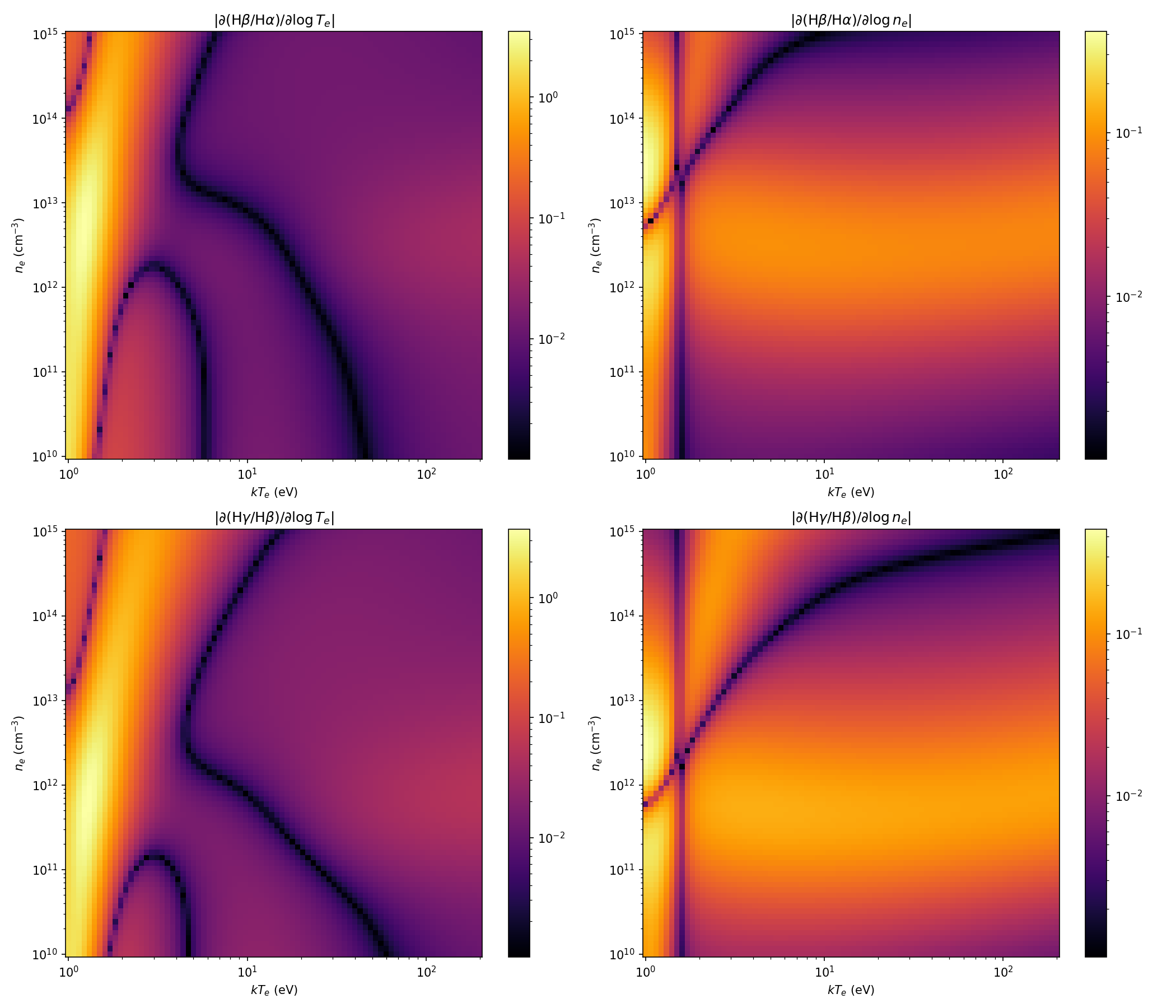
Sensitivity maps of the Hβ/Hα and Hγ/Hβ line ratios across the (Tₑ, nₑ) parameter space.
Overview
Measuring electron temperature and density is essential across fusion research, spacecraft propulsion, and industrial plasmas. Balmer-line spectroscopy offers a non-invasive way to do it — but only in the regimes where line ratios actually depend on the plasma parameters. I built a collisional-radiative (CR) model of atomic hydrogen to map exactly where those Balmer diagnostics are reliable, and where they break down.
The model tracks 15 energy levels, using electron-impact rate coefficients from Vriens & Smeets (1980) and oscillator strengths from Johnson (1972), with Einstein A-coefficients verified against tabulated quantum-mechanical values to better than 0.1%.
Approach
- Assembled the full rate matrix — electron-impact excitation/de-excitation, ionization, spontaneous radiative decay, and three-body recombination — and solved the steady-state populations with linear algebra (numpy.linalg.solve).
- Validated against the published results of Vinoth et al. (2022), and independently against the analytic coronal (low-density) and Saha–Boltzmann / LTE (high-density) limits.
- Extended the model to a time-dependent mode, integrating the rate equations forward with a stiff BDF solver (scipy.integrate.solve_ivp) to test oscillating plasma conditions.
- Used eigenvalue analysis of the rate matrix to extract the system's natural equilibration timescales independently of the full integration.
Key findings
- Temperature sensitivity of the Balmer ratios is confined to kTₑ ≲ 5 eV.
- Density sensitivity peaks in the collisional-radiative transition region, nₑ ∼ 1011–1013 cm−3.
- For oscillating conditions, the steady-state diagnostic assumption breaks down near ∼100 kHz at nₑ = 1010 cm−3, and only near ∼1 MHz at nₑ = 1015 cm−3 — and the time-dependent response shows nonlinear amplification effects.
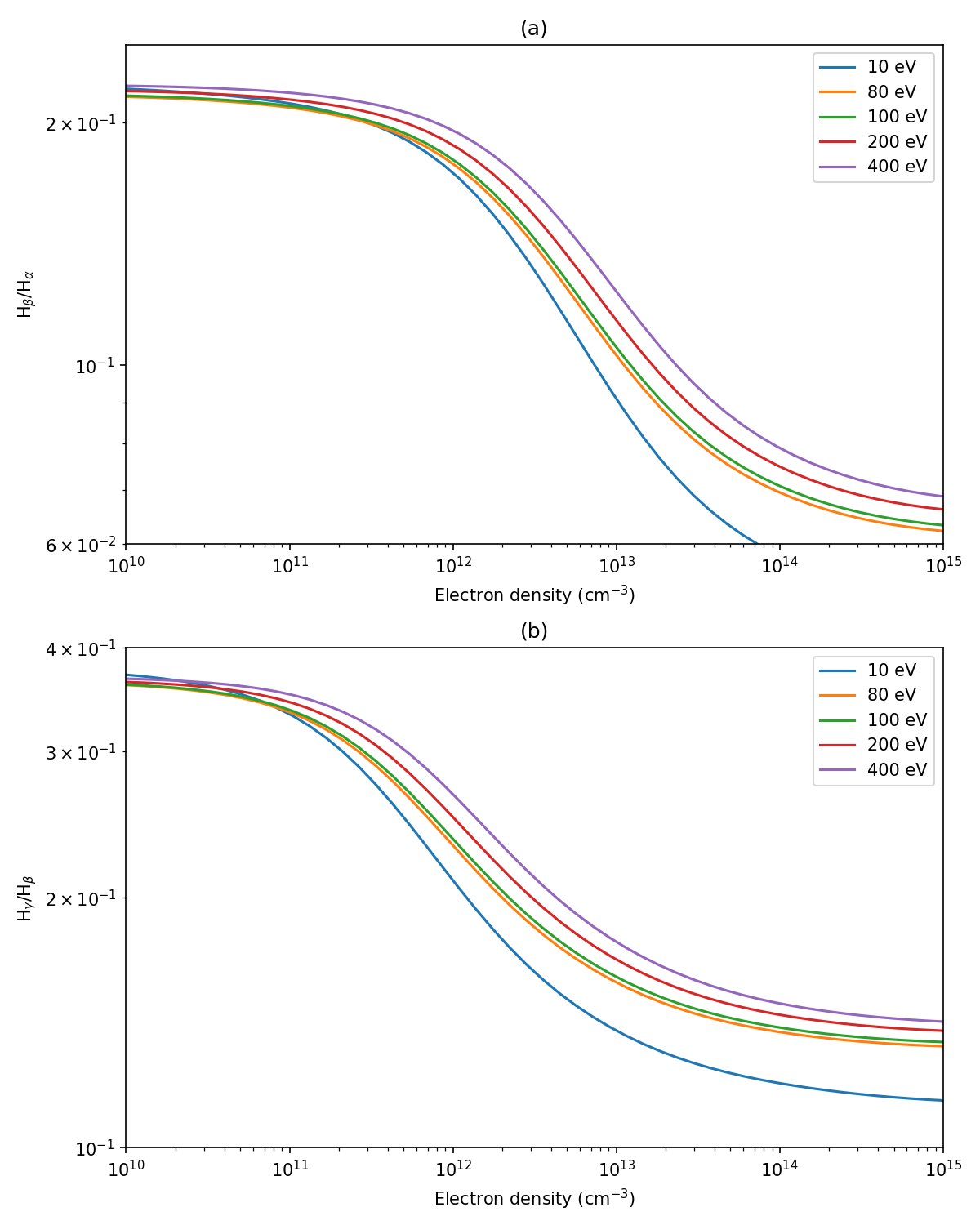
Model output validated against the published measurements of Vinoth et al. (2022).